
Active Directory

Manage, secure, and optimize Active Directory with guides on authentication, domain services, user management, and enterprise security best practices.

Diagram showing Active Directory FSMO roles including Schema Master, Domain Naming Master, RID Master, PDC Emulator, and Infrastructure Master with architecture layout
Active Directory

Active Directory FSMO Roles Explained (Deep Dive with Diagrams & Architecture)

Flexible Single Master Operations (FSMO) roles are a critical component of Active Directory, ensuring consistency in a distributed multi-master environment. While most directory operations allow multiple domain controllers to accept updates, certain tasks like schema modifications, RID allocation, and time synchronization require a single authoritative source. In this deep technical guide, we explore all FSMO
Active Directory Automation DNS DNS Security Microsoft PowerShell

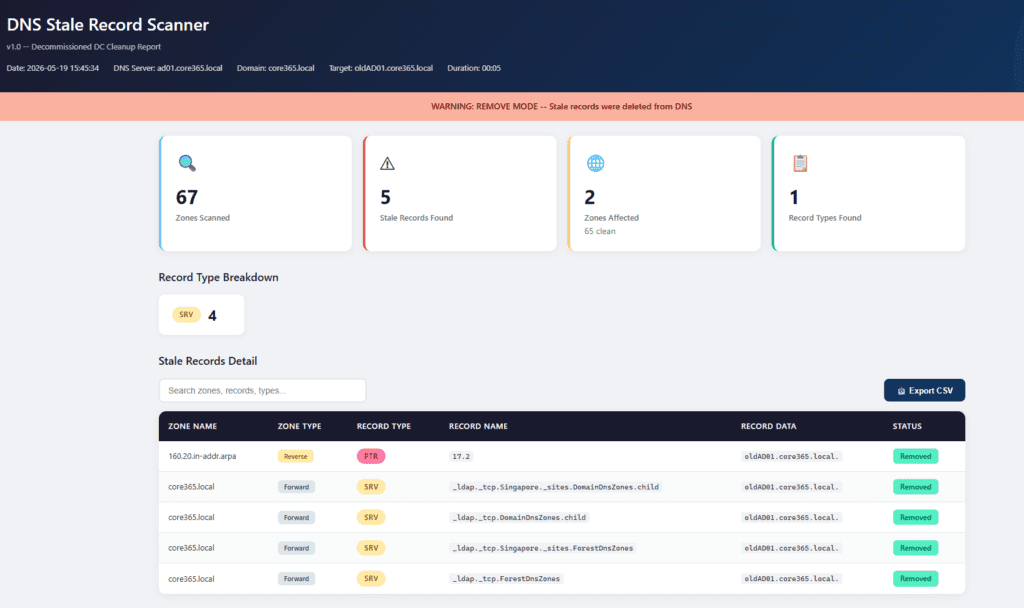
Core365 DNS Stale Record Scanner (PowerShell) – Clean Up Stale AD DNS Records Fast

The Real‑World Problem In real enterprise environments, DNS is never simple. You don’t just have one zone — you have: When a Domain Controller is decommissioned, DNS often keeps stale records behind: Manually checking and cleaning these across dozens (or hundreds) of zones is: The Solution – Core365 DNS Stale Record Scanner Core365-DNS-StaleRecord-Scanner is a

Technical feature image for Entra Connect user matching showing Soft Match versus Hard Match with enterprise-style icons.
Active Directory Exchange Server Microsoft 365

Microsoft Entra Connect User Matching: Soft Match vs Hard Match Explained

In a Microsoft hybrid identity environment, keeping your on-premises Active Directory (AD) users in sync with Microsoft Entra ID (formerly Azure AD) is critical. But what happens when you already have cloud-only users and you need to link them to on-premises accounts — without deleting them and losing their data? That’s where Soft Match and

GPO Duplicate Settings Analyzer HTML dashboard showing duplicate and conflicting Group Policy settings in Active Directory
Active Directory Group Policy Microsoft PowerShell

🛡️ GPO Duplicate Settings Analyzer v2.0 (Full Guide + Script)

⏱️ Estimated Read Time 6–8 minutes Managing Group Policy Objects (GPOs) in large Active Directory environments can quickly become chaotic. Over time, duplicate and conflicting settings creep in—leading to unpredictable behavior and long troubleshooting sessions. In this guide, you’ll learn how to identify GPO duplicates, detect conflicts, and clean up your environment using a powerful

Feature image for a real-time Active Directory replication dashboard built with PowerShell and HTML, showing live topology view, site-to-site summary, failed and stale replication links, and auto-refreshing dashboard health metrics.
Active Directory Automation Microsoft PowerShell

🚀 Real-Time Active Directory Replication Dashboard (PowerShell)

⏱️ Estimated Read Time – 6–8 minutes Active Directory replication issues are one of the most common hidden causes of outages, authentication failures, and inconsistent policies in enterprise environments. Yet most tools used today: 👉 That’s exactly why I built this: A real-time AD Replication Dashboard powered by PowerShell + HTML that transforms raw replication

Scroll to Top
×