

Flexible Single Master Operations (FSMO) roles are a critical component of Active Directory, ensuring consistency in a distributed multi-master environment. While most directory operations allow multiple domain controllers to accept updates, certain tasks like schema modifications, RID allocation, and time synchronization require a single authoritative source.
In this deep technical guide, we explore all FSMO roles in detail — including their internal mechanics, replication behavior, failure impact, and real-world deployment strategies — supported by architecture diagrams and interactive visualizations.
This article goes far beyond basic definitions—it dives into internal mechanics, replication behavior, failure impact, diagnostics, placement strategies, and real-world engineering considerations.
1. Why FSMO Roles Exist (Beyond the Basics)
Active Directory uses multi-master replication—any domain controller (DC) can accept changes, which are then replicated to others via Update Sequence Numbers (USNs) and High-Watermark vectors.
However, certain operations cannot safely run concurrently across multiple DCs due to:
- Uniqueness constraints (e.g., RID allocation, naming)
- Ordering dependencies (schema changes)
- Conflict resolution complexity too high for eventual consistency
FSMO roles implement strong consistency for these special operations.
2. FSMO Roles Overview and Logical Grouping
FSMO Roles Overview and Logical Grouping
| Scope | Role | Description | Count |
|---|---|---|---|
| Forest-wide Roles | |||
| Forest | Schema Master | Controls all updates and modifications to the Active Directory schema. | 1 per forest |
| Forest | Domain Naming Master | Manages addition and removal of domains and application partitions. | 1 per forest |
| Domain-wide Roles | |||
| Domain | RID Master | Allocates RID pools to domain controllers for unique security identifier creation. | 1 per domain |
| Domain | PDC Emulator | Handles authentication prioritization, time synchronization, and Group Policy updates. | 1 per domain |
| Domain | Infrastructure Master | Maintains cross-domain object references and ensures consistency. | 1 per domain |
3. Deep Dive: Each FSMO Role Internals
FSMO Roles – Deep Technical Breakdown
3.1 Schema Master (Forest-wide)
The Schema Master controls all modifications to the Active Directory schema partition, which defines object classes and attributes.
- Schema resides in the Schema Naming Context (NC)
- Updates modify:
- attributeSchema
- classSchema
- Changes trigger:
- Increment in objectVersion
- Forest-wide replication
- Schema updates are serialized via exclusive write lock
- Single authoritative writer enforced
- Replicates to all domain controllers in the forest
- Uses urgent replication for schema changes
- No impact on daily operations
- Blocks:
- Exchange installation
- Domain upgrades
- Application schema extensions
- Changes are rare
- Considered high-risk
- Managed by Schema Admins group
3.2 Domain Naming Master (Forest-wide)
Controls additions and removals of domains and application partitions in the forest.
- Creates and deletes domains
- Ensures uniqueness via:
- crossRef objects in Configuration NC
- Maintains forest namespace integrity
- Uses Configuration Naming Context
- Validates domain names globally before creation
- Coordinates with DNS infrastructure
- Cannot:
- Add/remove domains
- Add/remove application partitions
- No impact on authentication or daily operations
3.3 RID Master (Domain-wide)
Each security principal needs a unique SID:
SID = Domain SID + RID
- RID pools allocated to DCs (default size: 500)
- Each DC:
- Assigns RIDs locally
- Avoids cross-DC contention
- rIDAvailablePool
- rIDNextRID
- RID exhaustion protection
- Duplicate RID detection
- Maximum ~1 billion RIDs
- Event ID 16658 signals exhaustion risk
- Existing objects unaffected
- New object creation fails when:
- RID pool exhausted
- RID Master unavailable
3.4 PDC Emulator (Most Critical)
- Authentication Authority
- Password changes
- Account lockouts
- Fallback validation
- Time Synchronization
- Domain time source
- Kerberos dependency (<5 min skew)
- Group Policy
- Primary GPO editing DC
- Legacy
- NT4 compatibility
- Password updated on DC1
- Before replication:
- DC2 queries PDC for validation
- Receives urgent replication
- Ensures near real-time consistency
- Authentication failures
- Account lockout problems
- Time drift → Kerberos failure
Client → DC → PDC → External NTP
3.5 Infrastructure Master (Domain-wide)
Maintains cross-domain object references.
Ensures distinguished names remain correct across domains.
- Tracks phantom objects
- Updates:
- Distinguished Names
- GUIDs
- If all DCs are Global Catalog:
- Role becomes irrelevant
- Group membership inconsistencies
- No authentication impact
4. FSMO Roles and AD Replication Topology
FSMO roles do not replicate themselves; instead:
- The role ownership attribute is replicated
- Stored in:
fSMORoleOwnerattribute
AD uses:
- Knowledge Consistency Checker (KCC) to maintain topology
- FSMO roles rely on replication convergence for consistency of ownership
5. Role Placement Strategy (Real-World Architecture)
Small Environment (Single Domain)
- All roles on one DC
- Secondary DC ready for failover

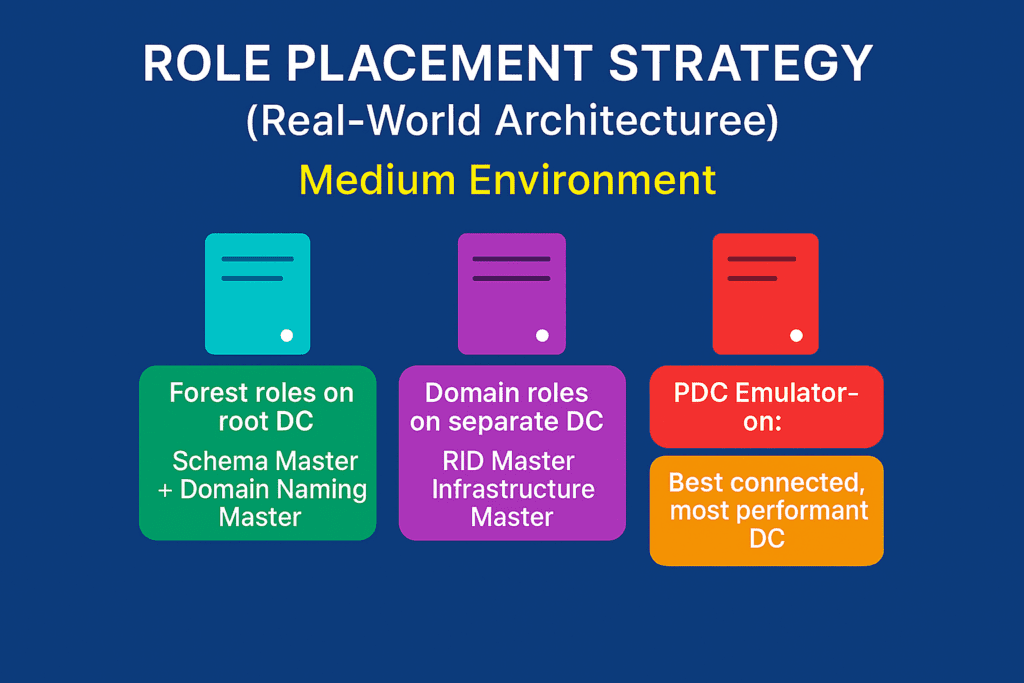
Medium Environment
- Forest roles on root DC
- Domain roles on separate DC
- PDC Emulator on:
- Best connected, most performant DC
Large Enterprise Environment
- Distribute roles:
- Schema + Domain Naming → forest root DC
- PDC → high-performance DC
- RID → stable DC
- Avoid:
- Placing Infrastructure Master on GC (unless all DCs are GC)

6. FSMO Transfer vs Seizure
Transfer (Graceful)
- Source DC is online
- Uses:
Move-ADDirectoryServerOperationMasterRole - Maintains consistency
Seizure (Forced)
- Source DC is offline permanently
- Risk:
- Conflicting role ownership if original comes back
- Required actions:
- Metadata cleanup
- Never reintroduce old DC
7. Monitoring and Troubleshooting FSMO Roles
Key Commands
netdom query fsmo
Get-ADDomain | Select RIDMaster
Event Logs to Watch
- RID exhaustion → Event 16658
- FSMO transfer/seizure → Directory Services log
Health Checks
- Replication:
repadmin /replsummary
- Time sync:
w32tm /query /status
8. Failure Scenarios and Real Risks
Scenario: Lost PDC Emulator
- Users unable to log in after password changes
- Kerberos failures due to time drift
Scenario: Lost RID Master
- DCs run out of RIDs → no new users/computers
Scenario: Split-Brain FSMO
- Happens if seized role and original returns
- Results in:
- Duplicate RID allocation
- Directory corruption
9. Advanced Insight: FSMO in Modern Hybrid Environments
With:
- Azure AD Connect
- Hybrid identity
The on-prem PDC Emulator remains critical for:
- Password hash sync timing
- Authentication authority
Even in cloud-first models, FSMO roles remain foundational.
10. Key Takeaways
- FSMO roles enforce strong consistency in a multi-master system
- PDC Emulator is the most critical role
- Proper placement and monitoring are essential
- Always prefer transfer over seizure
- Understand internal behavior—not just the role names
FSMO roles in Active Directory are specialized operations assigned to specific domain controllers to handle tasks that cannot run in a multi-master model, such as schema updates, RID allocation, and time synchronization.
There are five FSMO roles in Active Directory: Schema Master, Domain Naming Master, RID Master, PDC Emulator, and Infrastructure Master. Two are forest-wide and three are domain-wide roles.
The PDC Emulator is the most important FSMO role because it manages authentication, password changes, account lockouts, Group Policy updates, and time synchronization required for Kerberos.
Yes, FSMO roles can be transferred when the current owner is online or seized if the original domain controller has failed permanently.
If the RID Master fails, domain controllers can continue creating new objects only until their allocated RID pool is exhausted. After that, no new users or groups can be created.
The PDC Emulator acts as the main time source in a domain, which is critical for Kerberos authentication that requires all systems to be within a 5-minute time difference.
The Infrastructure Master maintains cross-domain object references and ensures that group memberships are updated correctly when objects are moved or renamed in different domains.
FSMO roles should be placed strategically. Forest-wide roles are typically on the root domain controller, while the PDC Emulator should be on a high-performance server and the RID Master on a stable domain controller.
Yes, all FSMO roles can be on a single domain controller in small environments, but larger environments should distribute roles for better performance and fault tolerance.
FSMO role transfer is a planned move between domain controllers, while seizure is a forced takeover when the original role holder is unavailable.
FSMO roles can be checked using the command netdom query fsmo or PowerShell commands like Get-ADDomain and Get-ADForest.

Antonio Rennvick is an IT Infrastructure Manager with 15+ years running enterprise Active Directory, Microsoft 365, and Azure environments. He’s Microsoft certified (AZ-104, MS-102) and writes Core365 Cloud to share what actually works in production—PowerShell automation, AD deep dives, and security hardening drawn from real-world work, not test labs.