
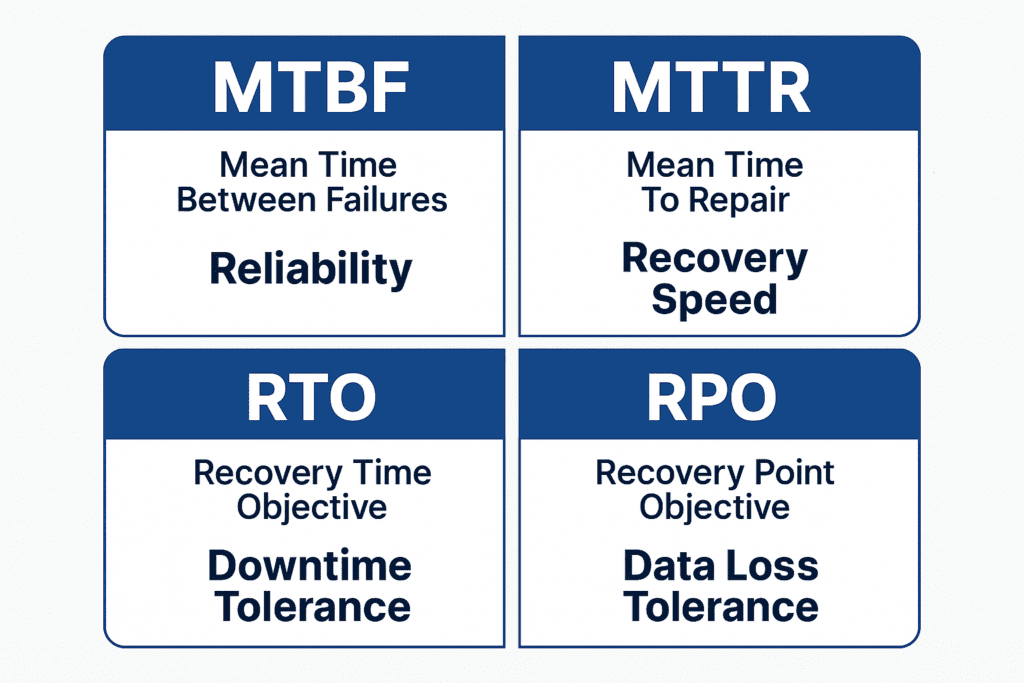
In today’s always-on digital world, downtime and data loss can directly impact revenue, customer trust, and business continuity. That’s why understanding key reliability and recovery metrics—MTBF, MTTR, RTO, and RPO—is critical for any IT team.
Although these terms are often used together, they serve different purposes. Let’s break them down in a simple, practical way.
What Is MTBF (Mean Time Between Failures)?
MTBF measures reliability. It tells you how long a system runs before something breaks.
📌 Formula
MTBF = Total uptime / Number of failures
✅ Example
If a system runs for 1,000 hours and fails 5 times:
- MTBF = 200 hours
👉 This means your system typically runs 200 hours before failing.
💡 Why It Matters
- Helps predict failure frequency
- Indicates system stability
- Useful for infrastructure and hardware planning
👉 The higher the MTBF, the more reliable your system is.
What Is MTTR (Mean Time To Repair)?
MTTR measures how quickly you recover when things fail.
📌 Formula
MTTR = Total repair time / Number of failures
✅ Example
If total downtime across failures is 10 hours:
- MTTR = 2 hours
👉 On average, it takes 2 hours to restore service.
💡 Why It Matters
- Measures incident response efficiency
- Impacts customer experience
- Critical for SLA performance
👉 The lower the MTTR, the faster your recovery.
What Is RTO (Recovery Time Objective)?
RTO is a business target—not a measurement.
It defines the maximum acceptable downtime after an outage.
✅ Example
- RTO = 4 hours
👉 Your service must be restored within 4 hours maximum.
💡 Why It Matters
- Defines acceptable downtime for the business
- Drives disaster recovery planning
- Impacts infrastructure investment
👉 If your MTTR is higher than your RTO, you have a problem ⚠️
What Is RPO (Recovery Point Objective)?
RPO defines how much data you can afford to lose.
It’s measured in time, based on backup frequency.
✅ Example
- RPO = 15 minutes
👉 You can only lose 15 minutes of data.
💡 Why It Matters
- Determines backup strategy
- Impacts storage and replication setup
- Critical for compliance and data protection
👉 The lower the RPO, the more advanced your data protection must be.
🔍 MTBF vs MTTR vs RTO vs RPO (Quick Comparison)
| Metric | Purpose | Measures | Type |
|---|---|---|---|
| MTBF | Reliability | Time between failures | Actual |
| MTTR | Recovery Speed | Time to fix issues | Actual |
| RTO | Downtime Tolerance | Max allowed downtime | Target |
| RPO | Data Loss Tolerance | Max data loss window | Target |
How These Metrics Work Together
✅ MTBF + MTTR = System Health
- MTBF = How often things break
- MTTR = How fast you fix them
👉 Together, they determine overall uptime and availability
✅ RTO + RPO = Disaster Recovery Strategy
- RTO = How quickly you must recover
- RPO = How much data you can lose
👉 Together, they define your DR and backup architecture
Real-World Example (E-commerce Platform)
Let’s say your system has:
- MTBF: 300 hours
- MTTR: 1 hour
- RTO: 2 hours
- RPO: 5 minutes
📊 Interpretation
- Failures occur roughly every 12.5 days
- Recovery is quick (1 hour) ✅
- RTO target (2 hours) is met ✅
- Minimal data loss allowed requires near real-time backups ✅
👉 This is a well-optimized, resilient system
Why These Metrics Are Critical
🚀 1. Improve Reliability
Tracking MTBF helps reduce system failures over time.
⚡ 2. Reduce Downtime
Optimizing MTTR improves service availability and user satisfaction.
🎯 3. Align IT with Business Goals
RTO and RPO ensure infrastructure matches business risk tolerance.
📜 4. Strengthen SLAs
These metrics are essential for:
- Service Level Agreements (SLAs)
- Compliance requirements
Common Mistakes to Avoid
❌ Confusing MTTR and RTO
- MTTR = actual recovery time
- RTO = expected recovery goal
❌ Ignoring RPO
Without RPO, backup strategies can fail during real incidents.
❌ Chasing 100% Uptime
Instead, focus on:
- Faster recovery
- Better fault tolerance
Best Practices
✅ Define Clear Targets
Set realistic RTO and RPO based on business impact.
✅ Automate Recovery
Use:
- Auto-healing systems
- Failover clusters
- Cloud redundancy
✅ Monitor Continuously
Track MTBF and MTTR trends to identify risks early.
✅ Test Disaster Recovery Plans
Run regular drills to validate your RTO and RPO.
✅ Final Thoughts
Understanding the difference between MTBF, MTTR, RTO, and RPO is key to building resilient systems.
- MTBF → Prevent failures
- MTTR → Recover faster
- RTO → Limit downtime
- RPO → Protect data
👉 Mastering these four metrics ensures your systems are not just available—but business-ready.

Antonio Rennvick is an IT Infrastructure Manager with 15+ years running enterprise Active Directory, Microsoft 365, and Azure environments. He’s Microsoft certified (AZ-104, MS-102) and writes Core365 Cloud to share what actually works in production—PowerShell automation, AD deep dives, and security hardening drawn from real-world work, not test labs.